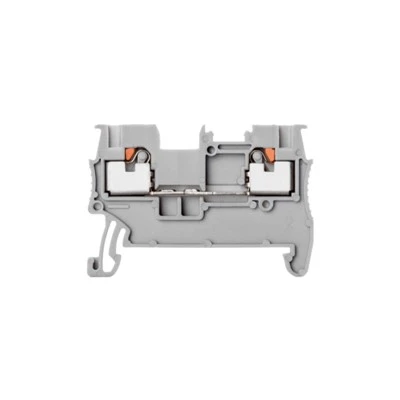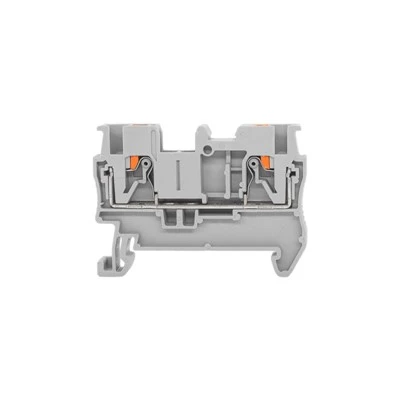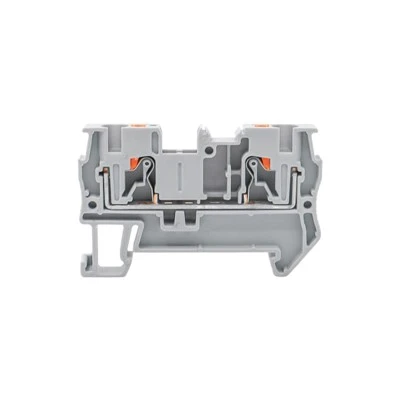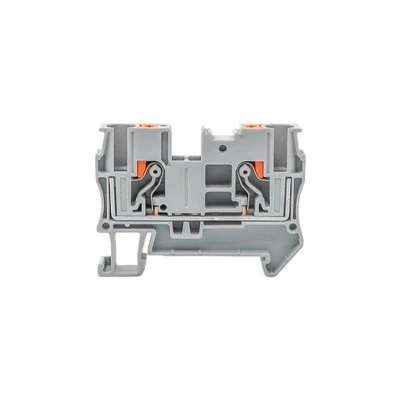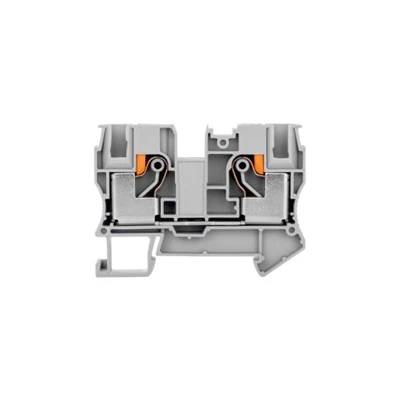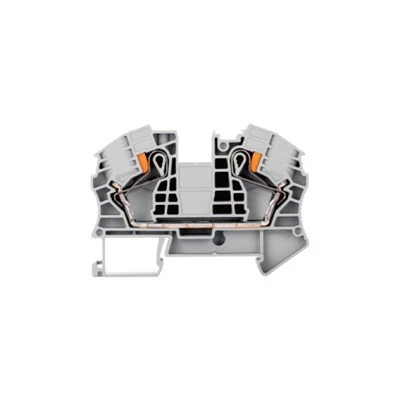
Terminal blocks are primarily classified based on three dimensions: connection structure, mounting form, and functional application. They encompass a wide range of types, including screw, spring-clamp, and pluggable versions.
Terminal blocks can be categorized into various types, including European-style, pluggable, transformer, building wiring, barrier-style, spring-clamp, DIN-rail mount, feed-through (panel-mount), and optocoupler terminal blocks. Also included are 110, 205, 250, and 187 series terminals; ring terminals (sizes OD2.2, 2.5, 3.2, 4.2, 2, 6.4, 8.4, 11, and 13); flag-type terminals and housings; various ring and tubular terminals; and copper/iron strips (e.g., 2-03, 4-03, 4-04, 6-03, 6-04).
Barrier-style
These enable safe, reliable, and effective connections and are widely used, particularly in high-current and high-voltage environments.
Spring-clamp style
These are a new type of terminal block utilizing spring-loaded mechanisms; they are widely used in the global electrical and electronics industries-including lighting, elevator control systems, instrumentation, power supplies, chemical processing, and automotive power systems.
Feed-through style
These utilize screw-connection technology; the insulation material is PA66 (flame retardancy rating: UL94, V-0), and the connectors are made of high-quality, highly conductive metal.
H-type feed-through terminal blocks can be mounted side-by-side on panels ranging from 1mm to 10mm in thickness. They automatically adjust to panel thickness variations, allowing for the assembly of terminal strips with any number of poles; isolation plates can also be used to increase air clearance and creepage distances. They can be securely mounted into rectangular panel cutouts without tools, making installation extremely convenient.
Pluggable style
These consist of two mating parts: one clamps the wire and plugs into the other, which is soldered onto the PCB. Based on sound mechanical principles, this vibration-resistant design ensures a long-lasting, airtight connection and reliable product performance. Mounting flanges can be added to the ends of the header; these protect the contact pins, prevent misalignment, and ensure correct mating with the socket. The headers may also feature mounting clips and locking latches. Mounting clips provide secure attachment to the PCB, while locking latches secure the header and socket together after installation. Various header designs accommodate different mating orientations-such as horizontal, vertical, or angled relative to the PCB-allowing for customization based on customer requirements. Compatible with both metric and standard wire gauges, these are the best-selling type of terminal block on the market.